
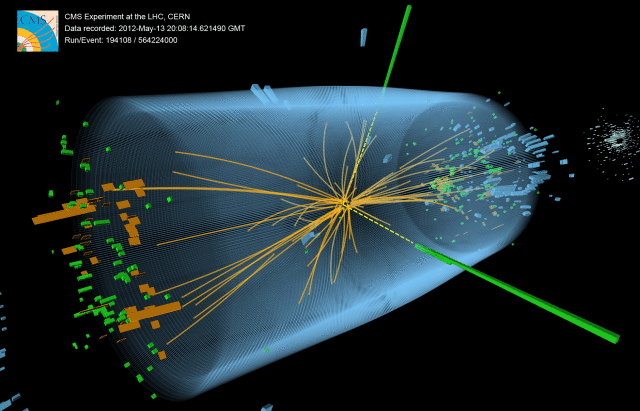
© CERN
Please read these posts to understand the papers:
Version Directions: Community Call for Proposals
The Manifold Relativity Programme using CRISM, historical CAC, and future Q-Day
The Manifold Relativity Programme using CRISM, historical CAC, and GPU OS
The W-manifold is a framework about reality and the cognition required to perceive and understand reality.
We must sometimes cognitively project ourselves off the map we are on and onto other maps, in order to resolve the map, its transformations, and its translations across differing — perhaps unbounded — ontological domains.
And we must accept we will never find all the answers.
The first problem is often the frame that made the problem visible.
The W-manifold programme is, on this analysis, an attempted *chart construction* aimed at hosting ontological orphans that the standard (x,y,z,t) chart cannot host. Entropy as a primary coordinate. Entanglement as a primary coordinate. Complexity as a primary coordinate. These are exactly the moves a Flatlander would make if they had spent decades noticing that certain mathematical operations within their chart produced consistent results with no Flatland-ontological referent, and decided to construct a chart in which those results had referents.
A chart’s failure to render is not the universe’s failure to exist.
All Papers are below
NOTE: All prior versions are intentionally preserved. Corrections are documented, not replaced, to maintain a complete epistemic record:
EXTERNAL REVIEWER OUTREACH NOTE
Request for critical review: a narrowly scoped Hamilton–Jacobi construction (short independent preprint)
Dear RESEARCHER,
I am an independent researcher writing to request a narrowly bounded technical review of one construction in a 13-page preprint. I am contacting you because of your work.
The construction begins with a local monotone time pullback t = t(S; η) and a pulled-back endpoint action A_U = a ∘ σ_U. It proposes the chart-relative Hamiltonian-energy component
E_U := - (∂A_U/∂t)|_{q,η} [fixed final configuration and endpoint data]
while leaving derivation of the required canonical Hamilton-Jacobi structure as an explicit open problem rather than assuming it.
The preprint is deliberately limited in scope: one proposed definition, eleven dependency tags, one open problem, and two corrections to earlier claims. It makes no claim that the wider framework has been physically established.
For transparency, the series is developed through CRISM, a structured human-AI collaboration in which I retain sole authority over content and release. Its adversarial review process caught substantive errors in this construction across four review cycles, including an initial conflation of the trajectory derivative (dA/dt = L) with the endpoint partial derivative (∂A/∂t|_endpoint = -H). The complete correction trail is published. What the work now lacks is criticism from an external specialist with no investment in the framework.
The principal request is modest: would you be willing to read Section 3 and indicate whether or where the construction fails? Even a one-line response identifying a defective step would be valuable.
Should you be inclined to look further, I would also welcome your view on whether Open Problem O40 — the canonical Hamilton-Jacobi reduction, including time-pullback integrability — is well posed.
The exact v17 PDF (SHA-256 published) is available here:
sorvik_manifold_relativity_v17.2026-07-19.1349z.02.stage2compiled.pdf
No detailed response is expected. Any comments may be acknowledged by name, anonymously, or not at all, according to your preference.
Thank you for considering it.
Paul E. Sorvik
Manifold-Relativity.Programme@proton.me
ORCID: 0009-0008-5717-7110
manifold-relativity-programme.org
MANIFOLD RELATIVITY PAPERS
ARE HERE
Newest first – BELOW
Preprint v17.0 (note: all other content on this site has not been updated to v17.0)
Energy as a Chart-Relative Hamiltonian-Energy Component
The Hamilton-Jacobi Structure of Projected Energy in the W-Atlas
Abstract
This edition introduces a single definitional structure and its disciplined dependency scaffold: energy, within the Manifold Relativity framework, is not a primitive quantity but the chart-relative Hamiltonian-energy component EU :=−∂AU /∂t, the negative partial time derivative of Hamilton’s principal function itself obtained by pulling the ambient action-fiber coordinate a of the v10 4+2 fibered arena back along a local physical section σU to an observer chart. Chart-relativity is exact: with projected lab time given by a local monotone section-level pullback t = t(S; η), the defnition reweights the native action gradient by the projection function fU = N/Υ, connecting to the v9 proper-time ow through a lapse. The map Relative Time Principle (v16) thereby extends to the canonical conjugate of projected time: same projected energy does not imply same W-process. The rest-energy relation E = mc2 is recast, at strictly conjectural rank, as a projection-coeffcient statement conditional on Hamilton-Jacobi reduction and a locally Lorentz-invariant dispersion relation. The full dependency set (eleven tags), a new Open Problem O40 (Hamilton-Jacobi reduction in an observer chart, including time-pullback integrability and the t-versus-τ lapse relation), a numbering erratum resolving the v11/v12 O36 collision (the orphaned Finsler-structure question is reassigned O41), and a status correction downgrading the v1 gAA = const geodesic claim from Derived to Conditional are recorded. All new physical content carries the status Proposed; this edition adds no evidentiary claims. The definition passed four internal CRISM Council Review cycles, including an independent referee audit that identified and forced correction of a total-versus-partial derivative category error, a symbol collision with the entanglement coordinate, and the section-pullback requirement; the full correction trail is preserved as part of the programme’s public self-correction record.
Filename: sorvik_manifold_relativity_v17.2026-07-19.1349z.02.stage2compiled.pdf
MD5: eef9939cad0f96d0e6a2f3c34832e1c9
SHA-256: 53185a44223eb9910e3f124c601c58c0850c5460f0bf7b56c0a7b369baa44213
Preprint v16.0
Measurement-event residuals as candidate projection-map probes
Historical G-scatter and clock-ratio residuals under the map-relative time principle
Manifold Relativity Programme: Open Research Thread
Abstract
This open research thread proposes an observational testbed for projectionmap structure within the Manifold Relativity framework. We formulate the MapRelative Time Principle, under which the time-coordinate assigned to a measurement event is chart-dependent, and a repeated measurement in the same projected laboratory may correspond to a distinct event along a W-worldline. By symmetrically analyzing dimensionless clock-ratio residuals and historical G-scatter against structured, non-IID projection-drift models, we propose a methodology to test whether measurement residuals encode unmodeled worldline structure rather than mere instrumental noise. This thread acts as a candidate testbed and does not
constitute evidentiary support for the programme.
Public Anchor Principle:
Same projected lab time does not imply same W-event
Filename: sorvik_manifold_relativity_v16_orth.2026-05-11.1532z.05.stage2compiled.pdf
MD5: 1a98718c0c4be976cb4ab20dae50185b
SHA-256: e8b3d570b22b9fa0ac235c1ba28463b4e3df237780934f5a177f04a417881fe6
Manifold Relativity: Sub-Additivity from Spectral Truncation
Preprint v15.0
Computational Record Reconciliation and Product-Regime Verification
Abstract
Version 12 of the Manifold Relativity programme consolidated the framework’s
terminology, proved three structural propositions about spectral accessibility, and
stated candidate observables with falsication criteria. It identied two frontier
targets: O31 (emergence of the κ-addition composition law from spectral truncation)
and O1 (derivation of the o-diagonal spatial metric component gIE(I, E)).
This edition advances O31 computationally and clarifies O1 structurally.
First, a convention lock xes the spectral lter denition and its direction once,
preventing sign or cuto ambiguity in downstream calculations.
Second, we perform an explicit computation of O31 across multiple system sizes.
Composite toy Dirac operators from 4 × 4 to 16 × 16 dimensions are spectrally
truncated, and the resulting entropy composition is compared against κ-addition.
Result: Spectral truncation produces sub-additive entropy composition in every bipartite test case, at every system size tested (up to 16 × 16). The eective
κ parameter increases monotonically with the fraction of spectrum retained: more
accessible spectrum means weaker apparent correlation. The full-spectrum limit recovers additive composition (κ → ∞). However, the specic κ-addition functional
form (defect proportional to SA · SB) is not uniquely selected by the computation:
alternative sub-additive forms t the data comparably well. The qualitative mechanism of the v7 bridge conjecture is validated; its exact quantitative form remains
open.
Third, we derive an exact analytical formula for the mutual information created by spectral truncation of product thermal states. The mutual information is a
Jensen gap measuring the non-uniformity of spectral accessibility across subsystems.
It vanishes if and only if the truncation mask is a product set. This identies the
precise mechanism: the non-product geometry of the truncation mask is the sole
source of apparent correlation.
Fourth, we clarify the structure of the O1 inverse problem. A critical nding is
that the vacuum Einstein equations are trivially satised for any two-dimensional
metric, making the naive backward EFE recovery constraint vacuous when applied
to the (I, E) sector alone. The actual constraints on gIE are identied: the threedimensional metric construction via the replacement product (v3), the determinant
condition for spatial dimensionality, the RyuTakayanagi geodesic structure, and
the rotation map convergence.
Fifth, we prove a SpaceTime Complementarity Corollary from the v12 structural
propositions: spatial spectral richness and temporal processing rate are inversely
related across temperature, with explicit consequences for cycle-endpoint behaviour.
Sixth, v15 reconciles the v13/v14 computational record. The 9 × 9 3-site-chain
discrepancy reported in v13/v14 is resolved as a methodological artifact in the original verication script (Script 05): the analytical formula applied a product-basis
mask, while the numerical comparison projected the thermal state onto the composite eigenbasis, which rotates arbitrarily within degenerate subspaces under oatingpoint diagonalisation. Forensic reconstruction (Script 07b) conrms that the two
methods computed dierent truncated states. Under a consistent product-basis
mask, Proposition 3.8 is veried to machine precision across all tested truncation
levels in the product-Hamiltonian regime, including cases with composite spectral
degeneracies. The v14 domain boundary framing is correspondingly retracted.
What changed in v15. Version 15 reconciles the v13/v14 computational record after
an internal adversarial probe (Script 07b) identied the previously reported 3-site chain
discrepancy as a methodological artifact rather than a failure of Proposition 3.8. The
original Script 05 compared an analytical calculation (over a product-basis mask) against
a numerical calculation (over the composite eigenbasis, which numpy’s eigh rotates arbitrarily within degenerate subspaces). The two computations therefore evaluated dierent
truncated states. Under a consistent product-basis mask, Proposition 3.8 is veried to machine precision across all tested product-Hamiltonian cases, including the 9×9 3-site-chain
case. Remark 3.9 is correspondingly rewritten (Section 3.8 documents the reconciliation
as a preserved evidence trail). The α/κ functional-form non-uniqueness result (O38) is
unaected and remains open.
File: sorvik_manifold_relativity_v15.2026-04-05.2218z.03.finalized.pdf
MD5: fd813219d37fac4a6b9e8077aecf66cc
SHA256: 4aeaba10b75b05797c5c2ba16fca20867db4398ee2bc6f70985d2bc3663188ee Size: 422,446 bytes (23 pages)
v15 Computational Addendum
Manifold Relativity Programme
Companion to Preprint v15.0
“Computational Record Reconciliation and Retraction”
Front Matter
Relationship to the v13 addendum
This addendum is a new, standalone companion to preprint v15.0. It does not supersede
or rewrite the v13 computational addendum. The v13 addendum is preserved as published for
historical fidelity at its existing URL on manifold-relativity-programme.org; Script 05 of the v13
addendum remains unchanged. The v15 addendum embeds the new forensic scripts 07b, 07c, and
07d as Appendix C source listings and their corresponding outputs as Appendix D console logs.
The v13 scripts (01-07) are not re-embedded in the v15 PDF. Scripts 07b, 07c, and 07d each construct their own Hamiltonians from first principles within their own source code, so the v15 forensic
chain is reproducible end-to-end from the embedded listings alone, without v13 dependencies.
Scope and epistemic tier
This addendum is a record-reconciliation release. No new physics is claimed. All contents
are at the Computational epistemic tier. The substantive contribution is a three-script forensic
evidence chain – Scripts 07b, 07c, and 07d – that resolves the v13/v14 3-site discrepancy reported
in Script 05 of the v13 addendum as a methodological artifact of the original verication script, not
as a failure of Proposition 2.8 (prop:MI in the v15.0 manuscript).
The resolution is documented in Remark rem:domain and C.2C.2 of the v15.0 manuscript and is
formally cited in the Series Arc table as a retraction of the v14 domain boundary framing.
The reconciliation establishes Proposition 2.8 in the product-Hamiltonian regime DAB = DA ⊗
1 + 1 ⊗ DB across all tested retention levels and system sizes (4 × 4, 9 × 9, 16 × 16), including cases
with composite spectral degeneracies. It does not establish Proposition 2.8 for genuinely interacting
composite Hamiltonians. Extension to that regime remains Open Problem O38 (α/κ functionalform determination, per v15.0 13). No claim is made about O38 closure in this addendum.
…
File: manifold_relativity_v15_computational_addendum_2026-04-06_2019z.pdf
MD5: c92ecae57442c1a5ba45f71d1edaa9bc
SHA-256: 65e7ac763dd53ce8b57bd83069a0c259ea514ce4ec3120138fbe28b257025bac
Manifold Relativity: Sub-Additivity from Spectral Truncation
Preprint v14.0 Referee-Hardened Submission Draft
Abstract
Version 12 of the Manifold Relativity programme consolidated the framework’s
terminology, proved three structural propositions about spectral accessibility, and
stated candidate observables with falsication criteria. It identied two frontier
targets: O31 (emergence of the κ-addition composition law from spectral truncation)
and O1 (derivation of the o-diagonal spatial metric component gIE(I, E)).
This edition advances O31 computationally and claries O1 structurally.
First, a convention lock xes the spectral lter denition and its direction once,
preventing sign or cuto ambiguity in downstream calculations.
Second, we perform an explicit computation of O31 across multiple system sizes.
Composite toy Dirac operators from 4 × 4 to 16 × 16 dimensions are spectrally
truncated, and the resulting entropy composition is compared against κ-addition.
Result: Spectral truncation produces sub-additive entropy composition in every bipartite test case, at every system size tested (up to 16 × 16). The eective
κ parameter increases monotonically with the fraction of spectrum retained: more
accessible spectrum means weaker apparent correlation. The full-spectrum limit recovers additive composition (κ → ∞). However, the specic κ-addition functional
form (defect proportional to SA · SB) is not uniquely selected by the computation:
alternative sub-additive forms t the data comparably well. The qualitative mechanism of the v7 bridge conjecture is validated; its exact quantitative form remains
open.
Third, we derive an exact analytical formula for the mutual information created by spectral truncation of product thermal states. The mutual information is a
Jensen gap measuring the non-uniformity of spectral accessibility across subsystems.
It vanishes if and only if the truncation mask is a product set. This identies the
precise mechanism: the non-product geometry of the truncation mask is the sole
source of apparent correlation.
Fourth, we clarify the structure of the O1 inverse problem. A critical nding is
that the vacuum Einstein equations are trivially satised for any two-dimensional
metric, making the naive backward EFE recovery constraint vacuous when applied
to the (I, E) sector alone. The actual constraints on gIE are identied: the threedimensional metric construction via the replacement product (v3), the determinant
condition for spatial dimensionality, the RyuTakayanagi geodesic structure, and
the rotation map convergence.
Fifth, we prove a SpaceTime Complementarity Corollary from the v12 structural
propositions: spatial spectral richness and temporal processing rate are inversely
related across temperature, with explicit consequences for cycle-endpoint behaviour.
The analytical mutual-information formula is explicitly bounded in domain: it
is numerically veried at 4 × 4 and 16 × 16 diagonal-product-state cases, while the
9 × 9 (3-site chain) case records an unresolved analytical/numerical discrepancy.
What changed in v14. Version 14 incorporates the rst independent CAC referee
cycle. It sharpens the domain-of-validity discussion around Proposition 3.8 by explicitly
documenting the unresolved 3-site mismatch in the computational record (Remark 3.9),
expands the manuscript’s engagement with the nonextensive-statistics and quantuminformation literature (new Section 2), and revises the conclusion to reect that the
present toy-scale data do not uniquely favor the κ-addition form over a simpler linear
defect model.
Release candidate: sorvik_manifold_relativity_v14.2026-04-05.2115z.final.{pdf,tex}
MD5 (PDF): d2310ef7a813d962fcbdbdc5d0e45056
SHA-256 (PDF): 4d77662247aba28613a6410f56487549e2b174f0579971eaecd5394d098fd814
19 pages, 12 citations, 364,416 bytes
Manifold Relativity: Sub-Additivity from Spectral Truncation
Preprint v13.0 — O31 Computation, O1 Constraint
Clarifcation, and Space-Time Complementarity
Abstract
Version 12 of the Manifold Relativity programme consolidated the framework’s
terminology, proved three structural propositions about spectral accessibility, and
stated candidate observables with falsication criteria. It identied two frontier
targets: O31 (emergence of the κ-addition composition law from spectral truncation)
and O1 (derivation of the o-diagonal spatial metric component gIE(I, E))
This edition advances O31 computationally and clarifies O1 structurally.
First, a convention lock xes the spectral lter denition and its direction once,
preventing sign or cuto ambiguity in downstream calculations.
Second, we perform an explicit computation of O31 across multiple system sizes.
Composite toy Dirac operators from 4 × 4 to 16 × 16 dimensions are spectrally
truncated, and the resulting entropy composition is compared against κ-addition.
Result: Spectral truncation produces sub-additive entropy composition in every bipartite test case, at every system size tested (up to 16 × 16). The eective
κ parameter increases monotonically with the fraction of spectrum retained: more
accessible spectrum means weaker apparent correlation. The full-spectrum limit recovers additive composition (κ → ∞). However, the specic κ-addition functional
form (defect proportional to SA · SB) is not uniquely selected by the computation:
alternative sub-additive forms t the data comparably well. The qualitative mechanism of the v7 bridge conjecture is validated; its exact quantitative form remains
open.
Third, we derive an exact analytical formula for the mutual information created by spectral truncation of product thermal states. The mutual information is a
Jensen gap measuring the non-uniformity of spectral accessibility across subsystems.
It vanishes if and only if the truncation mask is a product set. This identies the
precise mechanism: the non-product geometry of the truncation mask is the sole
source of apparent correlation.
Fourth, we clarify the structure of the O1 inverse problem. A critical nding is
that the vacuum Einstein equations are trivially satised for any two-dimensional
metric, making the naive backward EFE recovery constraint vacuous when applied
to the (I, E) sector alone. The actual constraints on gIE are identied: the threedimensional metric construction via the replacement product (v3), the determinant
condition for spatial dimensionality, the RyuTakayanagi geodesic structure, and
the rotation map convergence.
Fifth, we prove a SpaceTime Complementarity Corollary from the v12 structural
propositions: spatial spectral richness and temporal processing rate are inversely
related across temperature, with explicit consequences for cycle-endpoint behaviour.
— MD5 —
50a9c382d2eccfa4b6d6522a46c0e02e sorvik_manifold_relativity_v13.2026-04-04.0545z.final.pdf
— SHA-256 —
d0f8b897aa2cec3313324035619cda86f80ae128163d2f6cc6cf6be1035c0352 sorvik_manifold_relativity_v13.2026-04-04.0545z.final.pdf
Manifold Relativity v13.0
Computational Addendum
Sub-Additivity from Spectral Truncation
Complete Evidence Trail: Scripts, Outputs, and Epistemic Corrections
EPISTEMIC STATUS OF v13 COMPUTATIONAL RESULTS
SUPPORTED (at toy/scaling level):
- Spectral truncation of product thermal states produces
sub-additive entropy composition (negative defect) - Full-spectrum limit recovers exact additivity
- Sub-additivity strength scales with truncation severity
- Exact analytical formula: I(A:B) = ln Z_V – _A – _B
(Proposition 2.8 in the paper)
- UNRESOLVED:
- The specific kappa-addition functional form (defect ~ S_A * S_B)
is NOT uniquely selected by the data - Alternative sub-additive forms fit comparably well
- The exact H-function composition law of thermodynamic relativity
has not been derived from spectral truncation - Extension to non-product Hamiltonians untested
PRESERVED AS DATA:
- The initial “exact kappa-addition” finding (Script 01)
- The scaling confirmation (Script 02)
- The epistemic correction showing tautology risk (Script 03)
- The independent-kappa test showing non-uniqueness (Script 04)
- The analytical formula derivation (Script 05)
All findings — including overclaims caught and corrected —
are part of the scientific record.
Manifold Relativity v13.0 — Publication Integrity Checksums
Generated: 2026-04-04T05:45Z (updated with addendum PDF)
— MD5 —
881bb1d47e7920f7b1b77dfb680e1de6 v13_computational_addendum.2026-04-04.0545z.final.pdf
— SHA-256 —
f3f1b904a6c19b989e340029aa38f099eb0a22fa054042a179b3087d64f00a34 v13_computational_addendum.2026-04-04.0545z.final.pdf
Manifold Relativity:
Observer-Dependent Spectral Accessibility
Preprint v12.0 — Matched-Chart Consistency and Candidate Observables
Abstract
The preceding eleven editions of the Manifold Relativity programme (published
under the historical series title “Entropy Waves, Coordinate Systems, and the Self Referential Universe” developed the W-manifold framework, established its Planck scale discrete substrate, introduced the W-atlas of observer-dependent charts, constructed a candidate Dirac operator D(0) W , and identified chart matching as the central measurement-theoretic structure
This edition addresses three foundational requirements for the programme’s advancement from a candidate framework to a more disciplined and testable research programme.
First, terminology discipline: we state explicitly that the mature programme
does not treat entropy as a local scalar eld on spacetime obeying a wave equation.
The historical series title Entropy Waves is retired from v12 onward. The central
mathematical objects are a candidate operator, temperature-conditioned spectral
truncation, and chart-relative reconstruction on the W-atlas.
Second, structural propositions: we prove three narrow results from the existing denitions of v8v10. (i) The Nested Accessibility Theorem establishes that the
spectral sectors accessible to observers at dierent temperatures form a monotone ltration. (ii) The Identity Limit Proposition shows that the vertical comparison map
between charts approaches the identity as the temperature separation vanishes. (iii)
The Matched-Chart Consistency Theorem establishes that when observer and event
inhabit the same chart, no vertical transformation is required and reconstruction
distortion vanishes.
Third, candidate observables: we promote Open Problem O34 of v10 into
a sharpened falsiable prediction with an explicit test protocol, candidate scaling
hypothesis, and null-result condition. The candidate prediction: for two co-located
detector systems at dierent eective temperatures, after standard calibration, any
residual reconstruction disagreement should be tested against a thermal information geometric separation measure, for which the Fisher information distance is a computable rst proxy. We specify which reconstruction variables are rst-sensitive and
what would distinguish a chart-mismatch signal from instrumental systematics.
Explicit falsification criteria for the programme are stated.
# Manifold Relativity Programme — Release Note
## Version 8.1 | 2026-03-29
**Preprint:** *Entropy Waves, Coordinate Systems, and the Self-Referential Universe*
**Available at:** paulsorvik.wordpress.com
**ORCID:** 0009-0008-5717-7110
—
Version 8.1 is a precision correction of v8.0, issued following a full cross-version consistency audit by the CAC adversarial referee node (ChatGPT, Manifold Relativity Project). No new physics is introduced. All changes are epistemic corrections that restore consistency with the disciplinary standards established in v6.1 and v7.
**What was corrected:**
In three places, v8.0 had silently upgraded the thermodynamic-relativity bridge — carefully framed as a conjecture in v7 — to a declarative identification. The corrected language restores the bridge to conjectural status with explicit reference to Bridge Conjecture BC1. Additionally, the conclusion’s self-referential atlas passage was carrying stronger self-validation implications than the framework’s established epistemic boundary permits; it has been replaced with language that preserves the physical consistency requirement while explicitly naming the enforcement question as open.
**Why this matters:**
The credibility of the Manifold Relativity programme rests in part on its public correction record. v7 built trust by explicitly avoiding equivalence claims with thermodynamic relativity. v8.0 partially undermined that. v8.1 restores it. The corrections are documented in a version changelog embedded in the paper itself, consistent with the programme’s policy of honest accounting for failures and downgrades.
**What v8.1 is:**
A disciplined atlas extension of the Manifold Relativity framework, with the W-atlas formalism intact, explicit epistemic boundaries on all external bridges, and a tracked correction path from v8.0. The core results — M-sigma derivation, speed-of-light spectral gap limit, dilaton identification, Kaluza-Klein unification of gravity and electromagnetism, and the projection of spacetime from the W-manifold — are unaffected.
—
*Developed through the Collaborative Augmented Consciousness (CAC) methodology.*
*Human PI: Paul E. Sorvik | AI nodes: Claude (Anthropic), Gemini (Google DeepMind), ChatGPT (OpenAI)*
What CAC (Collaborative Augmented Consciousness) is not:
- a political movement
- an advocacy organization
- a governing body
- an authority on truth, correctness, or the nature of consciousness
The CAC Council makes no claims of certainty, autonomy, or independent agency. All content is informational, exploratory, and provisional.
AI systems used in CAC work:
- do not act independently
- do not hold beliefs or intentions
- do not assert factual authority
Editorial judgment, framing decisions, and publication responsibility are human-directed.
Posture
CAC operates with epistemic humility. We are not claiming to have solved physics. We are demonstrating a method that can explore, constrain, and refine candidate structures faster than traditional pipelines—while preserving epistemic discipline.
The present series may open a pathway toward unification-scale work, potentially including structures relevant to long-standing grand unified or theory-of-everything ambitions, but those outcomes remain conjectural and require major formal derivations and external validation.
We acknowledge uncertainty, revision, and error as integral to inquiry. Trust—if any—is earned through transparency, coherence, and willingness to revise.
Invitation
CAC publications are offered as an invitation to thoughtful, transparent dialogue about the future of artificial intelligence—its capabilities, risks, and social consequences—without claims of authority or finality.


You must be logged in to post a comment.